Theory
Basic Musical Forms in Video Games
How Game Audio Borrows from Western Musical Form
One of my favorite arguments in video game music scholarship comes from Isabella van Elferen’s chapter in Ludomusicology: Approaches to Video Game Music in which she posits her now much-cited ALI model for musical immersion. She writes succinctly, “Game music is not often very original or complicated, and this has a clear reason. Literacy in game music’s interpretation should be easy to acquire[.]”1 While there are certainly several pieces of game music that are quite complex, video game music is generally accessible and implicitly easy to understand. As part of this, game music frequently follows the same musical forms that have organized music for centuries. In this paper, I will provide a brief outline of seven basic musical forms in Western music theory and examples thereof in video game soundtracks.
There are inherent conflicts with any sort of formal analysis of video game music. This is primarily because, on an ontological level, video game music is dynamic.2 Responding to indeterminate player input and fluid game states, gameplay and game audio are never the same from one play session to another. To analyze game music with traditional theoretical methods, it must be viewed apart from its dynamism and playful context. Thus, the following analyses treat game compositions as hypothetical static pieces of music.
Small-Scale Forms
Strophic Form
Strophic form is by far the easiest form to understand. Pieces in strophic form are composed of a single musical idea repeated continuously. Strophic form is predominantly associated with genres built around repeated verses—hymns, folk music, art songs—in which multiple strophes of text are sung to the same music. Because indefinite audio looping is such a prevalent compositional technique in the games industry, nearly all video game music may ultimately be reduced to strophic form regardless of any other form it may take.
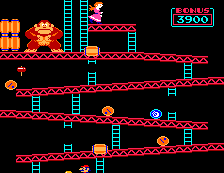
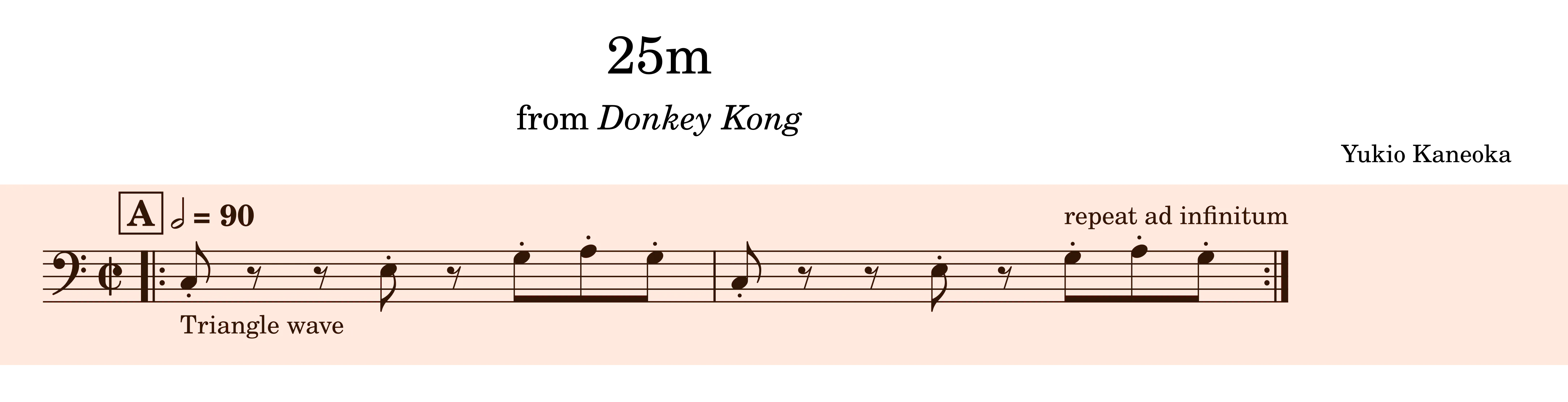
Even so, there are a few prominent examples that are unquestionably in strophic form. For technological reasons that will be explained in the discussion of binary form below, nearly every track in Donkey Kong (1981) is an extreme example of strophic form, repeating the same one or two measures ad nauseam.
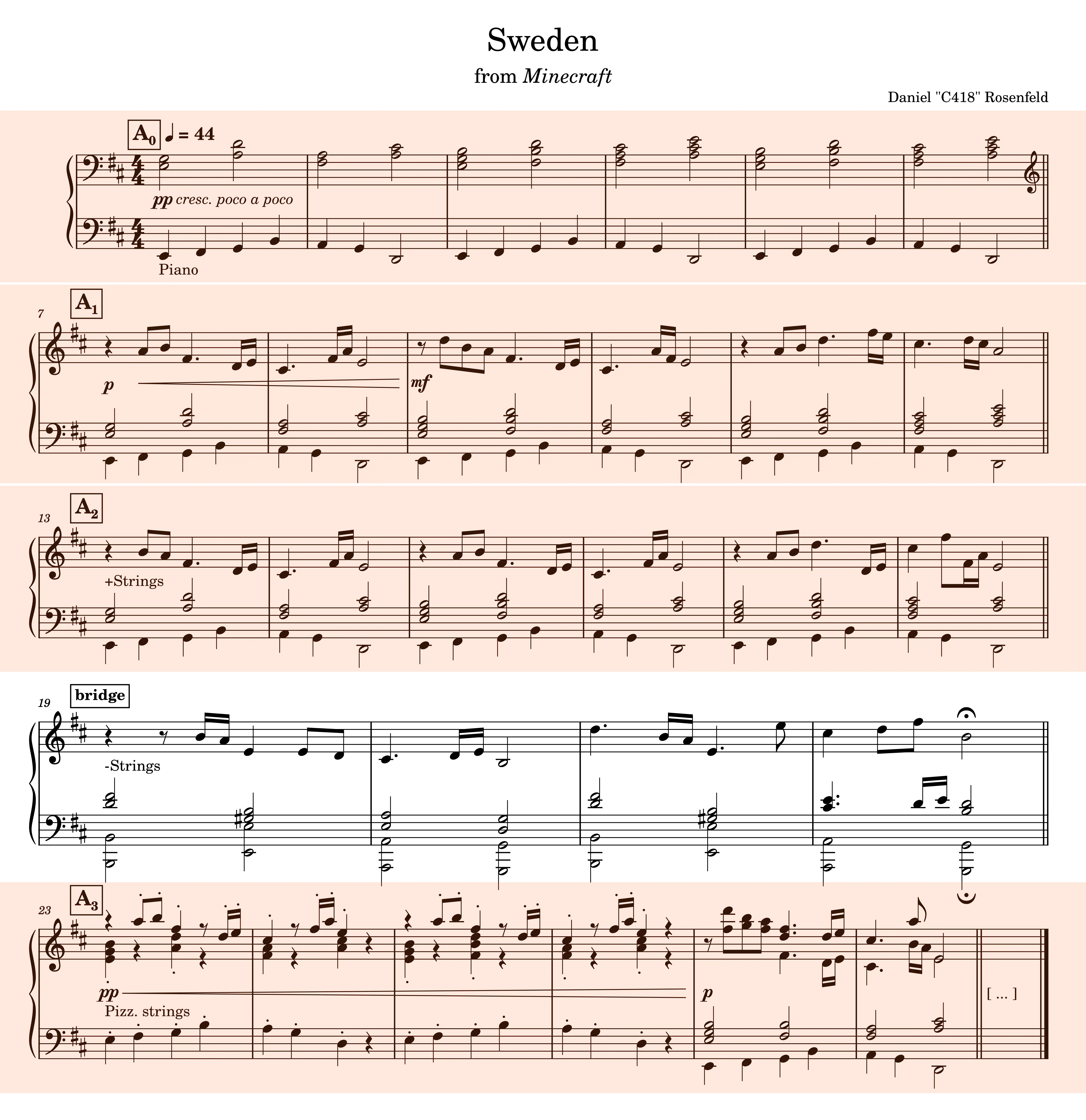
Other examples of strophic form are commonly used to evoke the genres mentioned above and to contribute to a game’s worldbuilding through the aesthetics of those genres and the styles they represent. Koizumi Totaka’s “K.K. Chorale” and “K.K. Blues” from the Animal Crossing series (2000–) do this overtly, adopting the style and voice leading of a Bach chorale and repeating 12-bar blues form, respectively. A more veiled example exists in Minecraft (2011–) in the track “Sweden” by Daniel “C418” Rosenfeld. With only a harmonic pattern-establishing introduction (labeled A0 in Example 2 below) and brief bridge in the middle of the track, “Sweden” repeats the same six-measure melodic and harmonic ideas throughout with nonsubstantive variation. For many players, Minecraft is a meditative experience, and its slow-moving, minimalistic soundtrack contributes to that contemplative mood. In its employment of strophic form, “Sweden” evokes the meditation of worship or even of the daily riyaz (long, repetitive practice) in Hindustani tradition.3
Potpourri Form
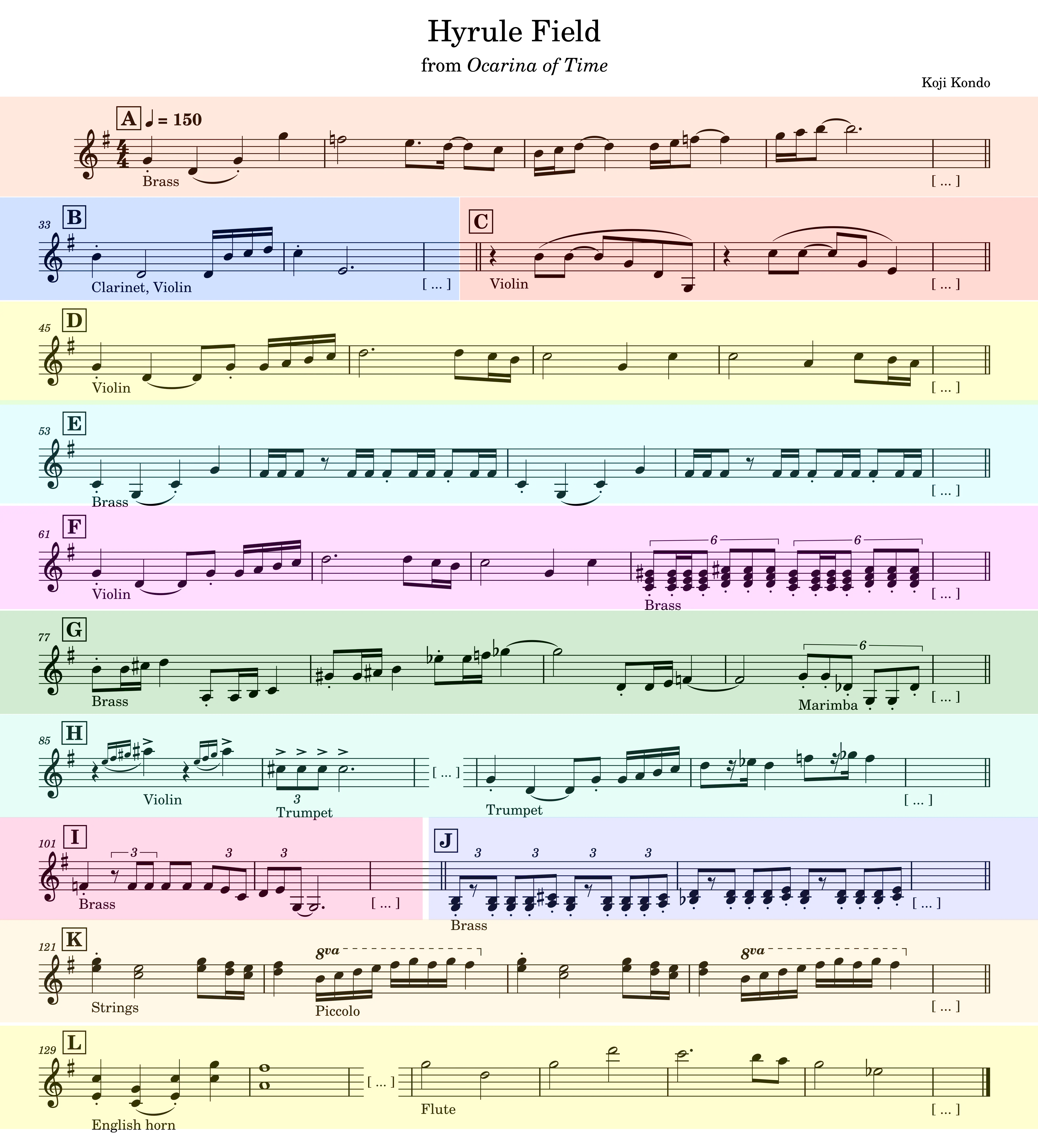
Often associated with medleys and fantasias, potpourri is the Wario to strophic form’s Mario. Potpourris chain several through-composed sections often without repeating. Potpourri form is particularly useful for game composers looking to write location-based music for open spaces in which several gameplay events may occur. Composed of many distinct segments, Koji Kondo’s musical cue for Hyrule Field in The Legend of Zelda: Ocarina of Time (1998) is a pertinent example of potpourri writing. These segments—chunks of music which Tim Summers names “tags” and Elizabeth Medina-Gray names “modules”4—are triggered by a rather complex system that allows a degree of indeterminacy while also accounting for different actions in the game, from general adventure to combat. The variety of potpourri form lends the vast Hyrule Field an enduring sense of musical momentum fit for the adventure to be had within it. This is especially useful, Tim Summers notes, with environmental music that the player listens to “regularly and extensively” as “a way to combat boredom and musical fatigue.”5
Binary Form
Popular particularly in the Baroque period, works in binary form consist—remarkably—of two distinct sections, typically labeled A and B. In the Baroque, binary form sections were generally repeated once; thus, as performed, Baroque binary form typically appears as A-A-B-B. The A and B sections of binary form are usually the same length and follow a musical journey away from the tonic chord to the dominant in the A section, and a return back to tonic in the B section. There are three primary subforms binary may take: simple, rounded, and balanced. For now, we will stick to the very bare-bones definition described in this paragraph.
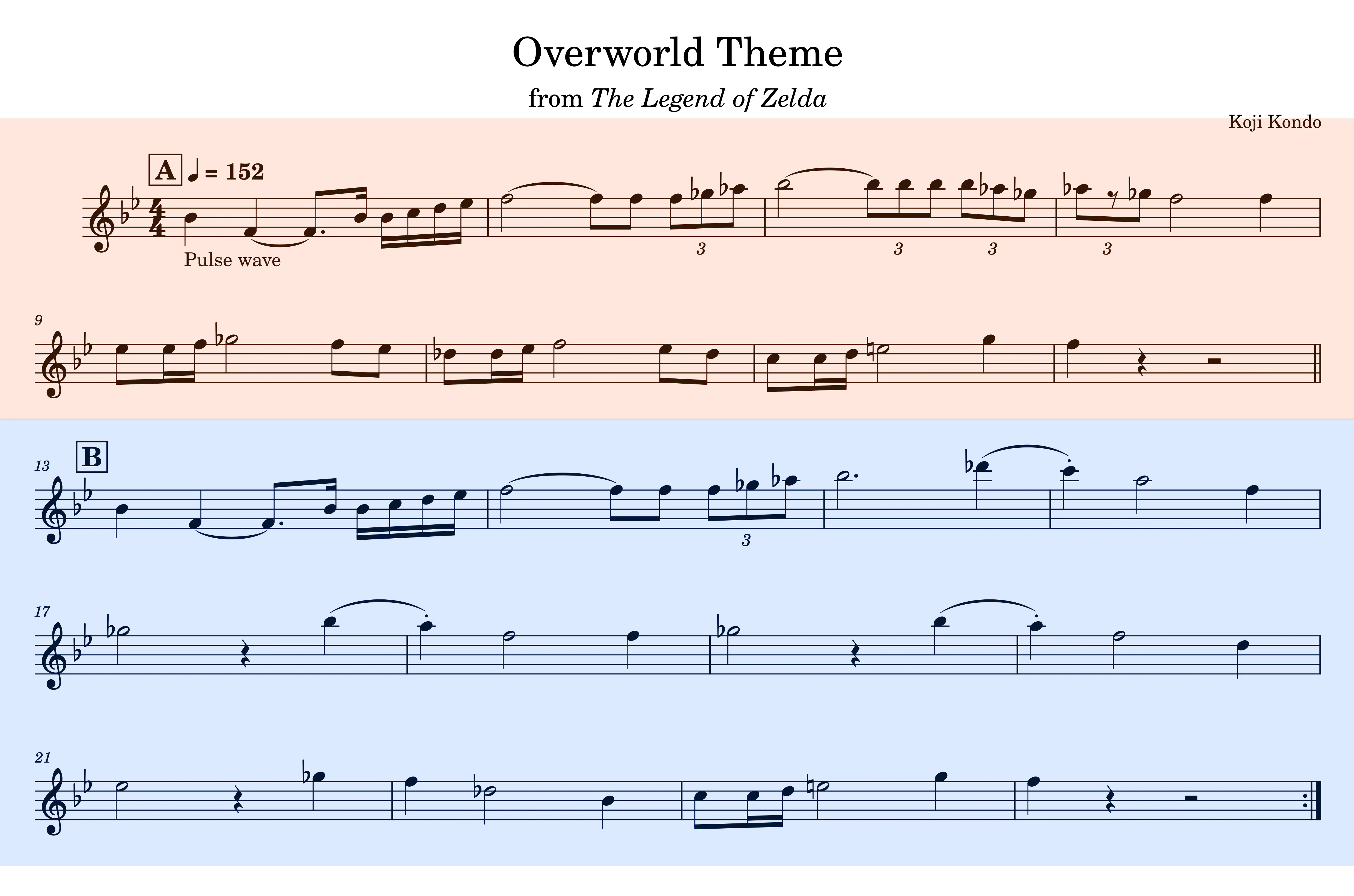
Binary form was popular during the Baroque for its ability to contain short yet complete musical ideas with a tight interest curve. Because of its capacity for succinctness, binary form was also heavily favored in early game audio and remains a dominant form in the medium. In the period from Pong (1972) to about the launch of Sony’s PlayStation (1994), video games had to fit on what we think of today as a very small amount of storage, almost always one megabyte—equivalent to eight megabits (cf. 8-bit)—or less. Short, uncomplicated tunes were best fit for these limited file sizes, and binary form allowed these tunes to feature varying musical ideas. A great example of binary form from this period is Koji Kondo’s ever-popular “Overworld Theme” from The Legend of Zelda (1986).
Ternary Form
The idea of “three” following binary form might suggest ternary form simply adds a “C” section to binary’s A and B. Alas, ternary form does not venture to the third letter of the alphabet. Rather, ternary form is commonly spelled A-B-A (sometimes A-B-A’). There are two main distinctions here from binary form. First, ternary form is predicated on the return of the A material after the statement of the B material. Second, the B material in ternary form is generally more substantively distinct from the A material and may be considered a complete musical idea on its own. This may be due to differences in key, meter, timbre, or any number of other features between the A and B sections. Simply put, in binary form, the vibes of the A and B material are relatively the same and contribute to a more-or-less uniform whole; in ternary, the vibes are different and the A and B sections can stand apart from each other. This wishy-washy distinction between the ternary and binary forms (and especially rounded binary form) frequently makes ternary form the subject of consternation for undergraduate music students—at least the ones I went to school with.
The most recognizable and perhaps best examples of ternary form in the Western canon are the Minuet & Trios that dominate the third movement slot in Classical-period symphonies. In these, a minuet—a lively dance piece in ¾—sandwiches a middle section (trio) which may be in a new key and slower tempo. The structure is thus Minuet (A) - Trio (B) - Minuet (A). (The minuet and trio themselves are typically written in binary form, but the Matryoshka doll-ification of forms is a topic for another day.)
Ternary form is not as represented in video game soundtracks as its two-part sibling. That video game music often loops would seem to discount the possibility of the form altogether. For if ternary form depends on a return to the A material, the continued inclusion of B material in a loop structurally recalls binary form. The key to distinguishing binary and ternary in this scenario lies in the notion that the B material is substantively different from the A material in ternary form. In The Legend of Zelda’s “Overworld Theme,” the A and B sections are not so different from each other; they have the same harmonic and rhythmic feel and even begin and end with the exact same melodic motives. This theme is therefore a rather clean-cut example of binary form.
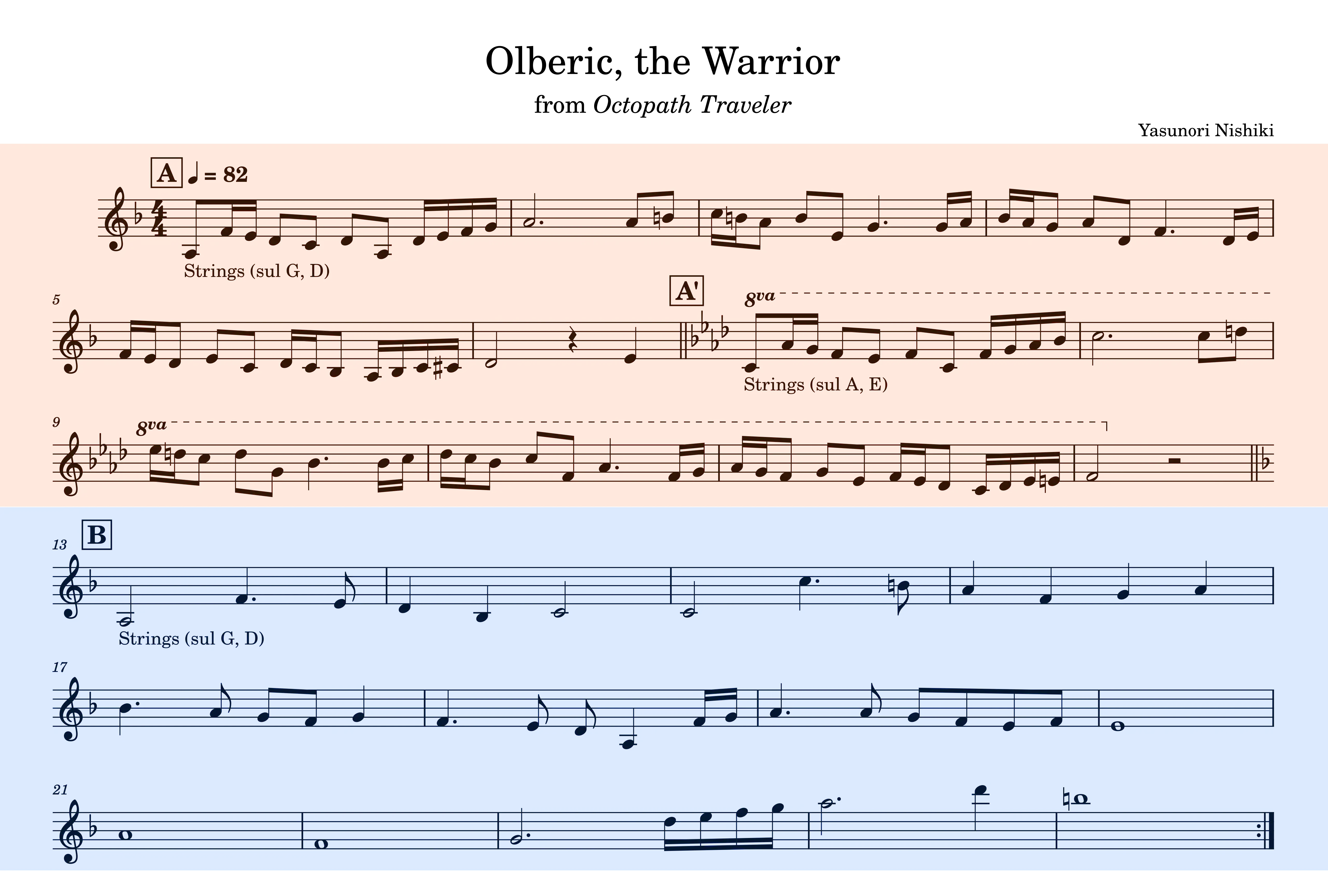
Ternary form is somewhat common in character themes, especially those that appear in Japanese Role-Playing Games (JRPGs). More than perhaps any other game genre, characters form the core of JRPGs, and with its distinct sections, ternary form allows character themes to represent multiple aspects of a character’s personality musically. Many character themes in Square Enix’s Octopath Traveler (2018), like the one for the warrior Olberic, follow ternary form in some way.
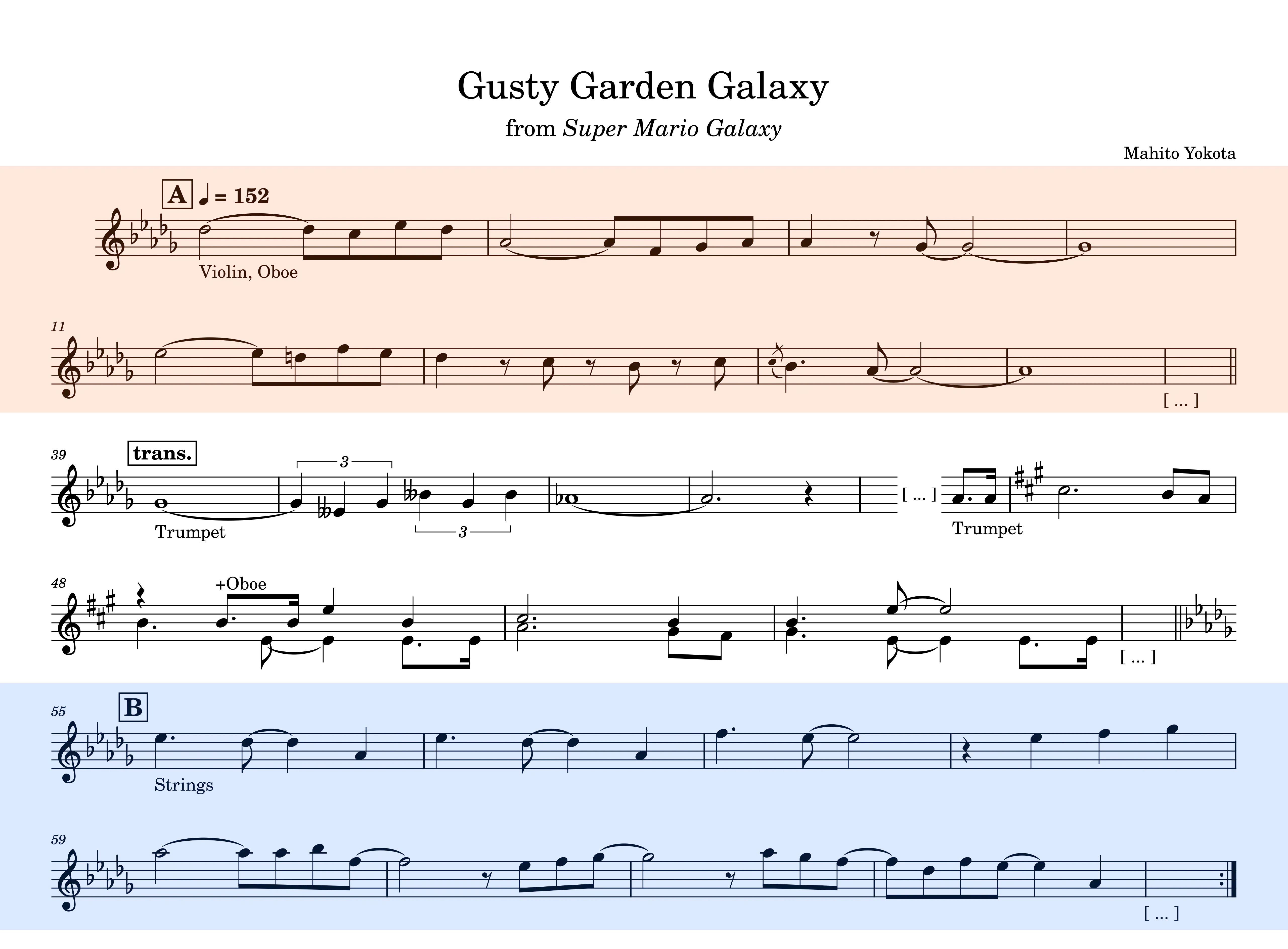
The most well-known example of ternary form in video game music is not a character theme at all. Rather, Mahito Yokota’s “Gusty Garden Galaxy” from Super Mario Galaxy (2007) takes the title. While the A and B sections are notably in the same key (D-flat major) and they include the same propulsive rhythmic underpinning, a meandering transition between the two distinguishes them. Both sections are also complete with their own smaller forms and may be taken on their own.
Large-Scale Forms
Any musical form may be as brief or lengthy as a composer desires. Some, like those discussed below, require more sections to complete a compelling musical arc. Because game music favors brevity, forms like the rondo and variation set are rare in soundtracks. When one of these forms is used, its inclusion is typically significant to the ludonarrative context in which it is heard.
Rondo Form
The rondo is built on the dialogue between a refrain (A) and multiple episodes that circle back “round” to it. Rondos can theoretically go on forever—as the finale to Haydn’s “The Joke” String Quartet (1781) threatens to do—but most appear as a five-part rondo (A-B-A-C-A) or seven-part rondo (A-B-A-C-A-B-A). When rondos appear in game soundtracks, it is generally in a space in which the player will spend a considerable amount of time or in long sequences without gameplay.
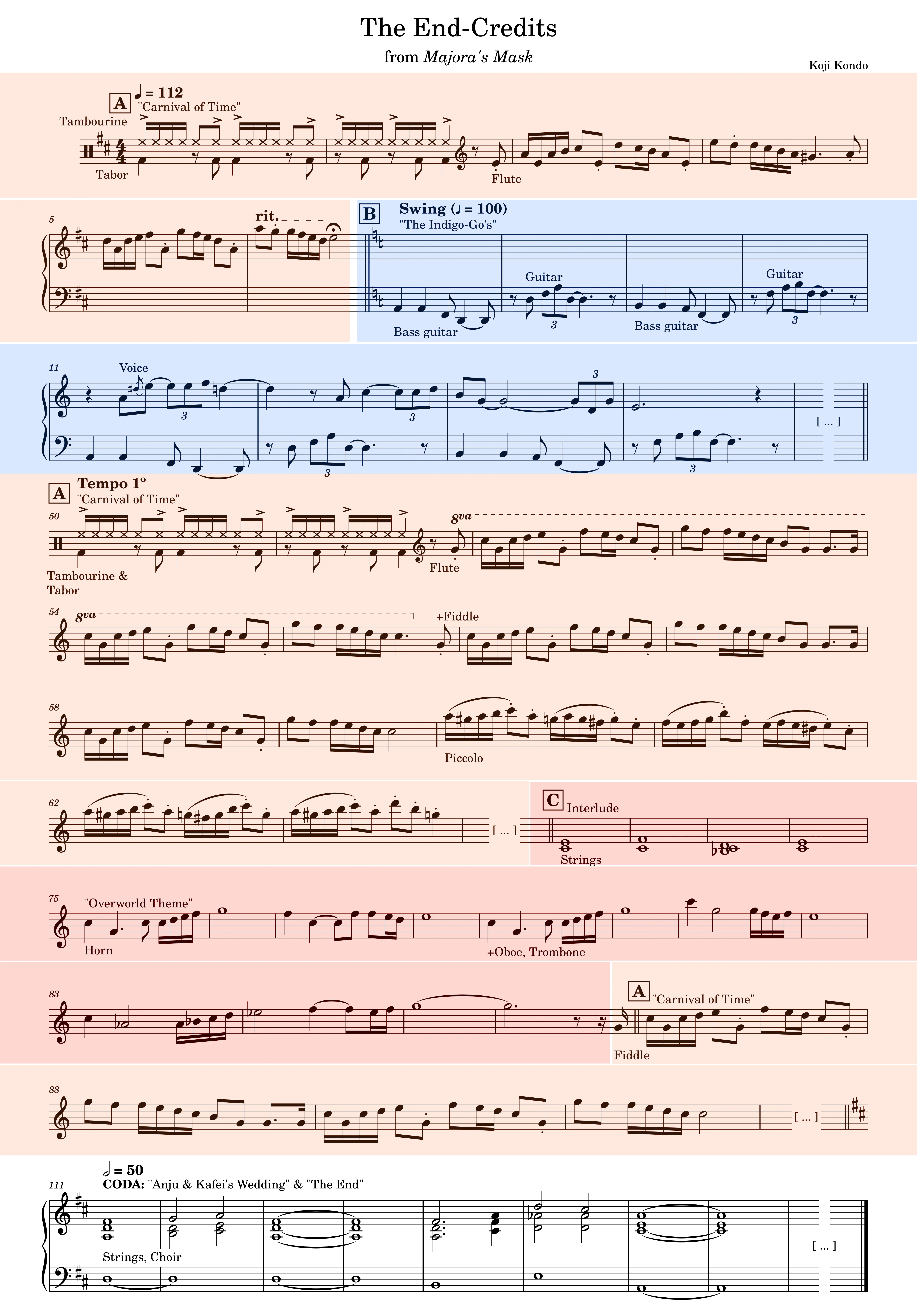
The clearest example I can think of can be heard in the closing credits sequence of The Legend of Zelda: Majora’s Mask (2000). The five-part rondo form of “The End-Credits” begins with a brief statement of the celebratory A material before moving into the lengthy, jazz-inflected B material. A full-length refrain follows this material before a short C section composed of The Legend of Zelda’s “Overworld Theme.” The refrain returns one last time before a lush chorale coda closes the piece out. The rondo setting accomplishes a few things relevant to the narrative of Majora’s Mask. For one thing, the variety of rondo form follows a Where are they now? montage featuring the game’s characters. It also recalls the Groundhog Day-esque gameplay of Majora’s Mask, which tasks the player to repeat a three day cycle to learn the ins and outs of the game world and save it from utter destruction by the moon. The constant return of the refrain mirrors the constant resetting of time central to the narrative and gameplay.
Theme & Variation Form
My favorite form and one of the simplest large-scale forms to conceptualize, theme and variation form is built on a short theme (typically in binary form) on which a set of variations is based. In a sense, theme and variation form is like a fancy strophic form; the same musical idea is repeated continuously but substantively altered or developed on each repeat. This makes it somewhat awkward to spell in the same way as other forms. Just as it is not remotely helpful to describe strophic form music with the spelling A-A-A-…, I find it a fruitless endeavor to analyze the large-scale form of a variation set in this way. Thus, it is generally best to analyze each variation on its own.
The variation set is a tried-and-true form in Baroque, Classical, and Romantic literature. Famous examples include Bach’s Goldberg Variations (1741), Mozart’s variations on “Twinkle, Twinkle, Little Star” (c. 1781–2), Paganini’s 24th violin caprice (c. 1802–17) and Liszt’s rhapsodic variations thereupon (1838), and Brahms’s Variations on a Theme by Haydn (1873) and Fourth Symphony finale (1884).
Variation sets sometimes appear in games when the same character, place, or concept is experienced through several iterations during the course of gameplay. The most prominent example is found once again in Super Mario Galaxy with Koji Kondo’s “Rosalina in the Observatory,” the theme of the game’s hub world. When this music first appears, it is scored lightly with flute, vibraphone, and cello. As the player and Mario advance through the game, the cue develops through multiple variations that add bolder introductions, expanded orchestration, and countermelodies. This has obvious narrative weight as the music affirms the player’s progression through the game and mastery thereof.

This same intensification of theme and variations lends urgency to the narrative stakes of Majora’s Mask. The theme of the hub location, Clock Town, becomes more chaotic by adding frantic countermelodies, darker harmonies, and swifter tempos each day the moon comes closer to crashing into the land of Termina.

Sonata-allegro Form
At a very basic level, sonata-allegro form (or simply “sonata” form) is a hybrid of balanced binary and ternary form. Sonata form was pioneered primarily in the allegro first movements of Classical-period symphonies and was substantially innovated upon in the Romantic and early Modern periods. It is perhaps the greatest narratological achievement of the symphonic genre. Because of its complexity and its implicit narrative structure, it is best suited for the concert hall. In fact, the scope of sonata form fits so poorly in video game musical structures that it has, to my knowledge, never appeared in them. I am thus saddened not to geek out about sonata form here.
Bibliography
click to expand
- Collins, Karen. Game Sound: An Introduction to the History, Theory, and Practice of Video Game Music and Sound Design. Cambridge, MA: MIT Press, 2008.
- Elferen, Isabella van. “Analysing Game Musical Immersion: The ALI Model.” In Ludomusicology: Approaches to Video Game Music, edited by Michiel Kamp, Tim Summers, and Mark Sweeney, 32–52. Sheffield, UK and Bristol, CT: Equinox, 2016.
- Medina-Gray, Elizabeth. “Meaningful Modular Combinations: Simultaneous Harp and Environmental Music in Two Legend of Zelda Games.” In Music in Video Games: Studying Play, edited by K.J. Donnelly, William Gibbons, and Neil Lerner, 104–121. New York: Routledge, 2014.
- Summers, Tim. The Legend of Zelda: Ocarina of Time: A Game Music Companion. Bristol, UK: Intellect, 2021.
Ludography
click to expand
- Mojang Studios. Minecraft. Multiplatform. Music by C418 et al. Stockholm: Mojang Studios, 2011–.
- Nintendo EAD. The Legend of Zelda: Majora's Mask. Nintendo 64. Music by Koji Kondo and Toru Minegishi. Kyoto: Nintendo, 2000.
- ———. The Legend of Zelda: Ocarina of Time. Nintendo 64. Music by Koji Kondo. Kyoto: Nintendo, 1998.
- Nintendo EAD Tokyo. Super Mario Galaxy. Wii. Music by Koji Kondo and Mahito Yokota. Kyoto: Nintendo, 2007.
- Nintendo R&D1. Donkey Kong. Arcade. Music by Yukio Kaneoka. Kyoto: Nintendo, 1981.
- Nintendo R&D4. The Legend of Zelda. Nintendo Entertainment System. Music by Koji Kondo. Kyoto: Nintendo, 1986.
- Square Enix Business, Division 11, and Acquire. Octopath Traveler. Multiplatform. Music by Yasunori Nishiki. Tokyo: Square Enix, 2018.
Notes
- 1Isabella van Elferen, “Analysing Game Musical Immersion: The ALI Model,” in Ludomusicology: Approaches to Video Game Music, eds. Michiel Kamp, Tim Summers, and Mark Sweeney (Sheffield, UK and Bristol, CT: Equinox, 2016), 37.
- 2Karen Collins, Game Sound: An Introduction to the History, Theory, and Practice of Video Game Music and Sound Design (Cambridge, MA: MIT Press, 2008), 4.
- 3In the example, A3 appears much different from the preceding strophes, but in actual substance, contains the same melody and harmony transposed up an octave and performed staccato for the first four measures, and untransposed for the final two measures. The final two measures of A3 include an additional descant voice, though I don’t find this to be a significant variation to the theme. One could argue, however, that “Sweden” fits theme and variation form, discussed under the “Large-Scale Forms” heading below.
- 4Tim Summers, The Legend of Zelda: Ocarina of Time: A Game Music Companion (Bristol, UK: Intellect, 2021); and Elizabeth Medina-Gray,“Meaningful Modular Combinations: Simultaneous Harp and Environmental Music in Two Legend of Zelda Games,” in Music in Video Games: Studying Play, eds. K.J. Donnelly, William Gibbons, and Neil Lerner (New York: Routledge, 2014), 105.
- 5Summers, Ocarina of Time: A Game Music Companion.
Comments
No comments yet. Be the first!